Why Does Every Piece of Pure Natural Leklai Have a Different Price? The Real Logic Behind Rarity, Energy, and Value

A Question Many People Arrive With
"They're both Leklai. Both from the same source. Both pure natural. Why does one cost hundreds and another cost tens of thousands?"
This is a completely reasonable question — and it deserves a complete answer, not a dismissive one.
Because the truth is: every single price difference in pure natural Leklai reflects specific, real, and verifiable factors. There is a genuine logic here. Understanding it transforms the way you look at Leklai and why certain pieces carry certain values.

The Most Fundamental Starting Point: Leklai Cannot Be Made
Before any of the specific pricing factors, there is one reality that underlies all of them:
Pure natural Leklai cannot be manufactured, batch-produced, customised, or replicated.
It forms in Malaysia's deep mountain caves across millions of years through processes completely beyond human control or acceleration. No technology can produce genuine Leklai in a factory. No process can create a second piece identical to an existing one. No amount of money can commission the earth to produce a specific variety in a specific quantity by a specific date.
Every piece that exists emerged from the mountain on its own timeline, in its own form, with its own energy state.
This natural irreproducibility is the foundation of all Leklai value. It means the supply of any specific type of high-quality Leklai is not just limited — it is finite and non-renewable. What has been collected is what there is. What hasn't been collected may never be found, or may emerge years from now in forms no one can predict.
Pricing Factor One: Collection Difficulty and Personal Danger
The physical process of bringing Leklai out of the mountain carries genuine, significant risk — and the difficulty level varies dramatically between varieties.
All Leklai collection requires deep mountain access: extended journeys into areas genuinely remote from civilisation, navigating terrain that has no marked paths, in conditions that include landslide risk, unstable rockface, and the particular hazards of mountain cave environments.
Buddha Column collection adds another layer entirely: the variety grows exclusively at cliff-face positions. Collectors must work at cliff edges in conditions where a single misstep is genuinely life-threatening. The seventh article in this series describes a real incident where a collector was buried by a landslide — a reminder that the danger is not theoretical.
The personal risk embedded in collection is real and significant. A piece that required extreme-difficulty cliff-face collection carries a premium that reflects the genuine danger of obtaining it. This is not arbitrary — it is the market recognising real human cost.

Pricing Factor Two: Bile Mineral Status
Not all Leklai is bile mineral (膽料). The distinction matters enormously for energy.
Bile mineral refers to the highest-density, most energy-concentrated portion of the Leklai mineral body. Pieces with significant bile mineral content have higher energy density, more concentrated Leklai benefits, and a more immediate, more distinct quality of energetic response when held.
HARUKA's Three Treasures are all entirely bile mineral — this is the fundamental reason for the Three Treasures' exceptional benefit strength, and reflects in their pricing.
For other varieties, bile mineral content varies significantly between pieces. A bile mineral seven-colour Leklai piece will command a meaningful premium over a non-bile mineral piece of the same variety and similar colour — because the energy difference is genuine and significant.

Pricing Factor Three: The Critical Statistic — Only 1-2% Has Colour
This is the number that, once you understand it, reframes everything about Leklai pricing.
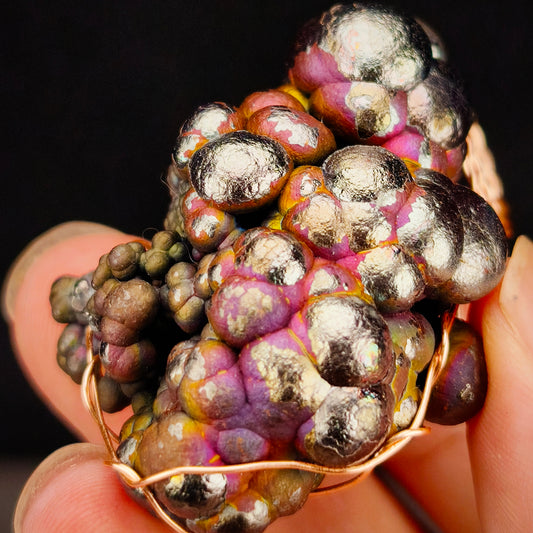
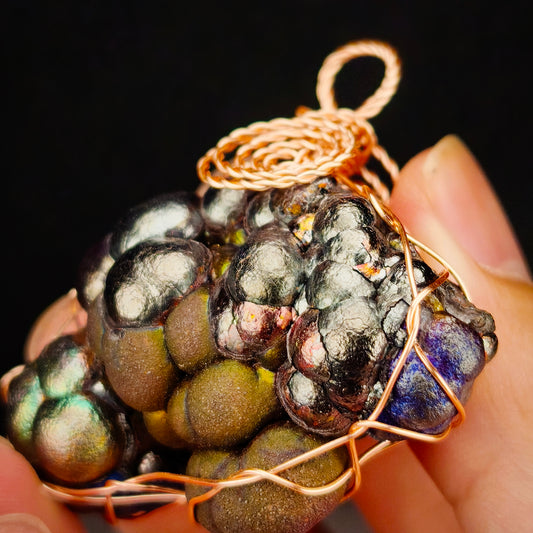
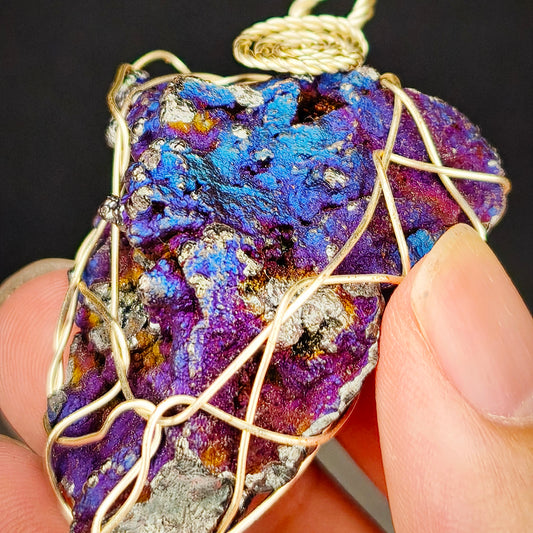
Of all the Leklai collected from a mountain, approximately 1-2% develops visible colour beyond the base old-shell brown-black.
The remaining 98-99% of collected Leklai is old-shell form — genuine, energetically real, historically and culturally significant, but without the vibrant colour expression that most people visualise when they think of Leklai at its most striking.
Why is colour so rare?
Because colour formation requires an extraordinarily specific simultaneous convergence: the right trace metallic elements present in the mineral's formation environment, the right oxidation conditions, the right geological pressure, the right temperature range maintained across the formation period, the right sealed environment allowing colour-producing chemistry to proceed without interruption across geological time.
Most Leklai in most locations doesn't have all of these conditions met simultaneously. So most Leklai forms without significant colour.
The 1-2% that does develop colour represents the rare intersection of all these conditions aligning correctly. This statistical rarity is the foundation of the price premium for coloured Leklai.

Pricing Factor Four: Collector-Grade Is 1-2% of the 1-2%
Here is where the pricing logic reaches its most striking conclusion.
Within the already rare 1-2% of Leklai that has colour, there is a further gradation: collector-grade represents approximately the top 1-2% of that coloured minority.
Let's do the arithmetic:
1-2% of all Leklai has colour.
1-2% of that coloured group qualifies as collector-grade.
This means collector-grade Leklai represents approximately 0.01% to 0.04% of total mountain yield.
In practical terms: in every 10,000 pieces collected from the mountain, perhaps 1 to 4 will be genuinely collector-grade.
And "collector-grade" is not just a label. It represents a specific combination of characteristics: exceptional colour vibrancy and evenness, significant colour variety within a single piece, ancient ore or bile mineral composition, completeness of form, and an energy state expressing at a distinctly higher frequency than standard coloured pieces.
The price premium for collector-grade Leklai is not marketing. It is mathematics.
Supply is extraordinarily constrained. The pieces themselves carry energy at a level that their colour directly expresses — because colour vibrancy and energy state in pure natural Leklai correlate directly and consistently. The most energetically active pieces are also the most visually striking.
Pricing Factor Five: Form Completeness and Special Natural Phenomena
Beyond variety, mineral age, and colour, the specific form of a piece carries its own pricing factors.
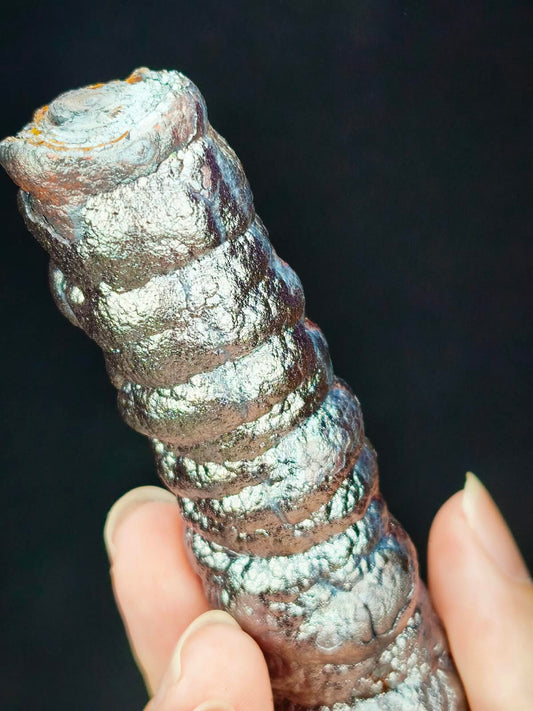
Buddha Column completeness: A Buddha Column with a complete natural round head preserved, 10cm or more in length, collected intact — this combination requires ideal collection conditions, excellent geological formation, and considerable skill and fortunate timing from the collector. These pieces are priced to reflect genuine rarity.
Special natural forms: Mountain shape, dragon form, wealth-cave/treasure-bowl form, animal silhouettes — these forms arise entirely from natural growth patterns and carry both rarity value (no two are identical, and not many achieve recognisable meaningful shapes) and the feng shui symbolic energy associated with the specific form.
Wealth Eye (財眼): Colour forming a circular eye-like pattern is among the rarest phenomena in all of Leklai. These pieces represent an extraordinary convergence of colour-formation conditions, and carry price points reflecting both rarity and the concentrated wealth energy symbolism.

Does Higher Price Always Mean Right for You?
After all of this pricing logic — which is real and valid — there is one final, important truth:
The highest price does not automatically mean the piece most suited to you.
The most expensive piece in any collection is the most expensive because of its measurable, objective characteristics: rarity, energy density, colour vibrancy, form completeness. These are real. They justify the price.
But Leklai is also a living stone that senses and responds. The most powerful piece in the room is not necessarily the one that resonates most specifically with you.
The piece that catches your eye and holds it — the one you keep returning to, the one that gives you that quiet but certain "this one" feeling when you hold it — that is still the most valid guidance.
Whether that piece is starter or collector-grade, that resonance is the truest signal.
Trust it.
FAQ
Q: Is an understated old-shell piece worth purchasing? A: Genuinely yes — particularly ancient ore old-shell. Mineral depth produces stable, mature, deeply rooted energy that has its own distinct character. Malaysian traditional home-building uses old-shell Xing Zai Bile for foundation protection specifically because old-shell energy is trusted, proven, and deeply real. Understated appearance does not mean weak energy.
Q: If two pieces are both "coloured," why can prices still vary dramatically? A: Because colour presence is the first threshold, not the final measure. Within coloured pieces, the gradations of vibrancy, evenness, colour variety, bile mineral content, mineral age, and form completeness all create meaningful energy differences — and corresponding price differences. All coloured Leklai is relatively rare. How rare, and at what energy level, varies considerably within that group.
Q: How do I know if a piece is genuinely collector-grade or just marketed that way? A: Genuine collector-grade pieces have a combination of characteristics that are visible and felt: exceptional colour vibrancy (not just some colour, but truly outstanding colour), often multiple colours in one piece, a quality of energy when held that is noticeably more immediate and present than standard pieces, and rarity that means the supply of such pieces is genuinely constrained. A seller who can't explain specifically why a piece qualifies as collector-grade should be questioned.
Further Reading — Recommended
👉 What Is Leklai Goethite? The Complete Beginner's Guide
👉 How Does Leklai Affect Emotions and Wealth? A Real Analysis
👉 Does Leklai Really Have Energy? Science, Experience & The Truth
👉 Seven Years of Real Leklai Stories
These articles will give you a fuller picture — worth reading before you decide.
🔥 One in ten thousand.
The piece that made you stop — the earth made it for a reason.